
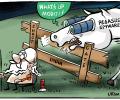
On October 29, WhatsApp announced it was suing NSO Group for selling its software, Pegasus, which has the ability to compromise a device and get access to all of a target's data. Spooked by revelations that activists and journalists were spied upon by using NSO Group's spyware, many have moved to alternative messaging platforms such as Signal and Telegram.

Chief Economic Advisor (CEA) V Anantha Nageswaran on Thursday said describing India's recovery as 'K-shaped' was wrong as both rural and urban economies were recovering, albeit at different paces. Speaking to reporters at the Finance Ministry, Nageswaran said the gross domestic product (GDP) growth print for the recent October-December quarter (Q3FY23) will likely be revised upwards. "The notion of using the letter 'K' to denote urban and rural is somewhat wrong because it is almost as if one is growing and one is contracting. "I would say one segment's slope is more positive, and the other one slope is less positive but it is positive," Nageswaran said.

Mining output climbed 23.3 per cent and power generation increased 7.5 per cent in May. The IIP had contracted 33.4 per cent in May 2020. Industrial production has been hit due to the coronavirus pandemic since March last year when it had contracted 18.7 per cent. It shrank 57.3 per cent in April 2020 due to decline in economic activities in the wake of the lockdown to curb the spread of coronavirus infections. The IIP had registered a growth of 5.2 per cent in February last year.

Retail inflation declined to a one-year low of 5.72 per cent in December 2022, mainly due to softening prices of food items, according to official data released on Thursday. The Consumer Price Index (CPI) based retail inflation was at 5.88 per cent in November 2022 and 5.66 per cent in December 2021.

Retail inflation breached the RBI's comfort zone and rose to a three-month high of 6.52 per cent in January, mainly on account of a spike in food prices, as per government data released on Monday. The inflation rate based on the Consumer Price Index (CPI) stood at 5.72 per cent December and 6.01 per cent in January 2022.
The government's decision to release the reports comes two days after over 200 scholars from across the globe issued a statement demanding release of all withheld reports produced by the NSO, including the household consumer expenditure survey that was junked.

Retail inflation eased to 4.06 per cent in January, mainly on account of a decline in vegetable prices, as per government data released on Friday. The inflation based on Consumer Price Index (CPI) was 4.59 per cent in December 2020.

As per the data released by the NSO, the overall food inflation rose to 14.12 per cent in December as against (-) 2.65 per cent in the same month of 2018.

The parliamentary panel on information technology will question government officials on allegations relating to suspected phone tapping of politicians, journalists and others using Pegasus spyware, the committee chairman and senior Congress leader Shashi Tharoor said on Tuesday, and asserted that it is the "most important issue" for many members.

Top officials in key ministries, including finance and IT, are of the opinion that a sensitive payments system such as UPI should not be on a platform whose security is possibly compromised.
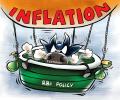
RBI Governor Shaktikanta Das on Friday said that inflation is on a declining trajectory, as it has fallen by 170 basis points from its January 2020 peak. Retail inflation fell to four-month low of 5.91 per cent in March over the previous month, mainly due to easing food prices.

The Index of Industrial Production (IIP) grew by 1.4 per cent in November as most components like manufacturing, electricity, mining, primary goods, and consumer durables witnessed a slowdown, according to data released by the National Statistical Office (NSO) on Wednesday. This is on the base of a decline of 1.7 per cent in November 2020 and before the new Covid variant started impacting economic activity. IIP growth was lower than the 4 per cent expansion recorded in the previous month but was better than a 1.6 per cent contraction seen in November 2020. Separately, rising prices of kitchen staples pushed retail inflation, or rate of price increase, to 5.59 per cent in December 2021, bringing it close to the upper band of Reserve Bank's comfort zone.

India's economy grew 6.1 per cent in the fourth quarter of 2022-23, pushing up the annual growth rate to 7.2 per cent, official data showed on Wednesday.

Experts said a dip in consumption expenditure indicated an increasing prevalence of poverty in the country.
Most of the economic activity in the country had come to a standstill after the government imposed a 21-day nationwide lockdown beginning March 25 to check the spread of coronavirus.
The retail inflation, which is factored in by the RBI to arrive at its monetary policy, has been on decline since last month. The previous low was 5.54 per cent in November 2019. The government has asked the RBI to restrict the inflation around 4 per cent, with a margin of 2 per cent on the either side.

After contracting for two quarters in a row, the Indian economy entered the positive territory with a growth of 0.4 per cent in the October-December quarter, mainly due to good performance by farm, services and construction sectors, official data showed on Friday. Trade and hotel industry registered a contraction of 7.7 per cent during the third quarter this fiscal, as the sectors continued to suffer on account of coronavirus pandemic. According to the data released by the National Statistical Office (NSO), the farm sector recorded a growth of 3.9 per cent, and the manufacturing sector output grew by 1.6 per cent in the quarter under review.

The government, however, dismissed allegations of any kind of surveillance on its part on specific people, saying it 'has no concrete basis or truth associated with it whatsoever'.

Industrial production re-entered the negative territory by contracting 1.6 per cent in January, mainly on account of the decline in output of capital goods, manufacturing and mining sectors. The output of the manufacturing sector -- which constitutes 77.6 per cent of the Index of Industrial Production (IIP) -- shrank by 2 per cent in January, as against a growth of 1.8 per cent during the same month last fiscal, as per data released by the government on Friday. The worst performance was witnessed by the capital goods sector, which recorded a contraction of 9.6 per cent during the month under review, compared to a 4.4 per cent decline a year ago.
Retail inflation softened to 6.71 per cent in July due to moderation in food prices but remained above the Reserve Bank's comfort level of 6 per cent for the seventh consecutive month. With retail inflation continuing to remain high despite a fall in prices of vegetables and edible oils, among other commodities in July, the Reserve Bank of India (RBI) might go for another rate hike in September. The Consumer Price Index (CPI) based retail inflation was at 7.01 per cent in June and 5.59 per cent in July 2021. It was above 7 per cent from April to June this fiscal.

More than 300 verified mobile phone numbers, including of two serving ministers, over 40 journalists, three opposition leaders and one sitting judge besides scores of business persons and activists in India could have been targeted for hacking through an Israeli spyware sold only to government agencies, an international media consortium reported on Sunday.

In twin blows to Indian economic revival, higher food prices drove retail inflation to a five-month high of 7.4 per cent while factory output fell for the first time in 18 months. The second consecutive month of rise in consumer price index (CPI)-based inflation will add to the pressure on the Reserve Bank of India (RBI) to again raise interest rates to tame high prices. Inflation has been above the targeted zone for the ninth month in a row and as per statute, the RBI will now have to explain to the government in writing why it failed to keep prices below 6 per cent.

People familiar with the proceedings said independent cybersecurity experts from a private consulting firm, technology lawyers, government officials and WhatsApp representatives were asked questions about the Pegasus spyware and the larger issues surrounding surveillance, hacking and remedial measures.

The Wire has reported that phone numbers of multiple people close to Dubai Princess Sheikha Latifa, who was captured by Indian soldiers in 2018, were added to a list of potential targets for surveillance.
Retail inflation eased to 7.04 per cent in May, mainly on account of softening food and fuel prices as the government as well as the RBI stepped in to control spiralling price rise by way of duty cuts and repo rate hike. However, the inflation print stayed above the Reserve Bank's upper tolerance level of 6 per cent for the fifth month in a row. The Consumer Price Index (CPI) based retail inflation was 7.79 per cent in April.

Most rating agencies had projected contraction in India's GDP for the first quarter of 2020-21.
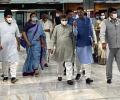
BJP members of the panel who were present in the meeting room didn't sign the attendance register in protest leading to a lack of quorum required for holding the meeting.

India's economic growth slowed to 3.1 per cent in January-March and to an 11-year low of 4.2 per cent for the full fiscal 2019-20 amid a drop in consumption and investment. The Gross Domestic Product (GDP) growth stood at 5.7 per cent in the corresponding quarter of 2018-19, according to data released by National Statistical Office (NSO) on Friday.

Domestic ratings agency Icra on Monday forecast a 2 per cent GDP growth in the fourth quarter of 2020-21, and a 7.3 per cent contraction for the full fiscal year. From a GVA or gross value added perspective, the agency pegs Q4 growth at 3 per cent and the full year contraction at 6.3 per cent. According to the agency, the 2 per cent projected GDP growth will help the economy avoid a double-dip recession as indicated by the National Statistical Office (NSO) for Q4. Icra's projection is better than the 8 per cent contraction forecast by the NSO as it sees Q4 growth at only 1.1 per cent.
"For women, the Pegasus scandal is deeply concerning, for speaking out against the state and men in positions of state power has meant that their lives are wrecked by such surveillance permanently.

She also took a swipe at the Bharatiya Janata Party over its defeat in the just-concluded Himachal Pradesh assembly elections, saying the ruling party's president could not hold on to his home state. "Who is the Pappu now?" she asked.

The country's demographic dividend is dissipating, with seriously adverse consequences for young India, asserts Shankar Acharya, former Chief Economic Adviser to the Government of India.

Pushed by rising prices of essential kitchen items, the retail inflation rose to an eight-month high of 7.34 per cent in September, making the RBI's task to push growth by reducing the interest rate even more difficult in coming the days. The Consumer Price Index (CPI)-based inflation was 6.69 per cent in August and 3.99 per cent in September 2019. Inflation has been hovering above 4 per cent since October 2019.

Indian economy is likely to rebound with an 8.9 per cent growth in the fiscal year beginning April 2021 after economic activity showed significant improvement in the last quarter, IHS Markit said on Friday. The National Statistical Organisation (NSO) on Thursday predicted that the economy will contract 7.7 per cent in the current financial year ending in March, the worst performance in four decades.

Counsels for AgustaWestland VVIP chopper scam accused Christian Michel and fugitive diamantaire Nirav Modi were also the potential targets of Israeli spyware Pegasus.

Industrial production contracted by 1.9 per cent in November, entering the negative territory after a two-month gap, mainly due to poor showing by manufacturing and mining sectors, official data showed on Tuesday. The manufacturing sector -- which constitutes 77.63 per cent of the index of industrial production (IIP) -- recorded a contraction of 1.7 per cent in November 2020, as per data released by the National Statistical Office (NSO). Mining sector output too witnessed a decline, shrinking 7.3 per cent.

India's GDP is estimated to contract by a record 7.7 per cent during 2020-21 as the COVID-19 pandemic severely hit the key manufacturing and services segments, as per government projections released on Thursday. Amid overall decline in economic activities, some respite was provided by the agriculture sector and utility services like power and gas supply, which have been projected to post positive growth during the current fiscal ending March 2021.

Claims of a spike in poverty and inequality in India during the Covid-19 pandemic are patently false as such claims are based on uncomparable different surveys, according to a paper co-authored by eminent economist Arvind Panagariya. The paper also noted that inequality fell in the country during Covid years, both in rural and urban areas as well as nationally. Panagariya, Columbia University Professor and former vice chairman of NITI Aayog and Vishal More of Intelink Advisors, New Delhi have co-authored a detailed paper 'Poverty and Inequality in India: Before and After Covid-19'.

NSO has pegged economic growth at 5 per cent in 2019-20 in its second advance estimates.

Industrial production growth entered positive territory after a gap of two months with a record 22.4 per cent rise in March this year, mainly due to the low-base effect and good show by manufacturing, mining and power sectors. The manufacturing sector -- which constitutes 77.63 per cent of the index of industrial production (IIP) -- grew by 25.8 per cent in March 2021, as per the data released by the National Statistical Office (NSO) on Wednesday. The mining sector output too grew 6.1 per cent in March, while power generation increased by 22.5 per cent.
